


What Examiners Look for in a Driving Test: The 2026 Guide to Passing
Taking the Maryland MVA driver's skills test is a major milestone, but it’s normal to feel anxious about what the examiner is writing on their clipboard. Many new drivers worry they’ll fail for one small mistake. The good news is that MVA examiners aren't looking for absolute perfection. They have one primary goal: to confirm you are a safe, predictable, and responsible driver who can be trusted alone on the road.
This guide demystifies the process by showing you exactly what examiners look for in a driving test. By shifting your focus from "how not to fail" to "how to demonstrate safety," you can walk into the MVA with the confidence and skills to succeed.
Table of Contents
- The Examiner’s Mindset: Safety Over Perfection
- The Pre-Drive Inspection: Passing the "First Impression" Test
- Core Driving Competencies: What Is on the MVA Scoresheet?
- Critical Driving Errors: Avoiding the Automatic Failure
- Mastering the Test with Professional Confidence
The Examiner’s Mindset: Safety Over Perfection
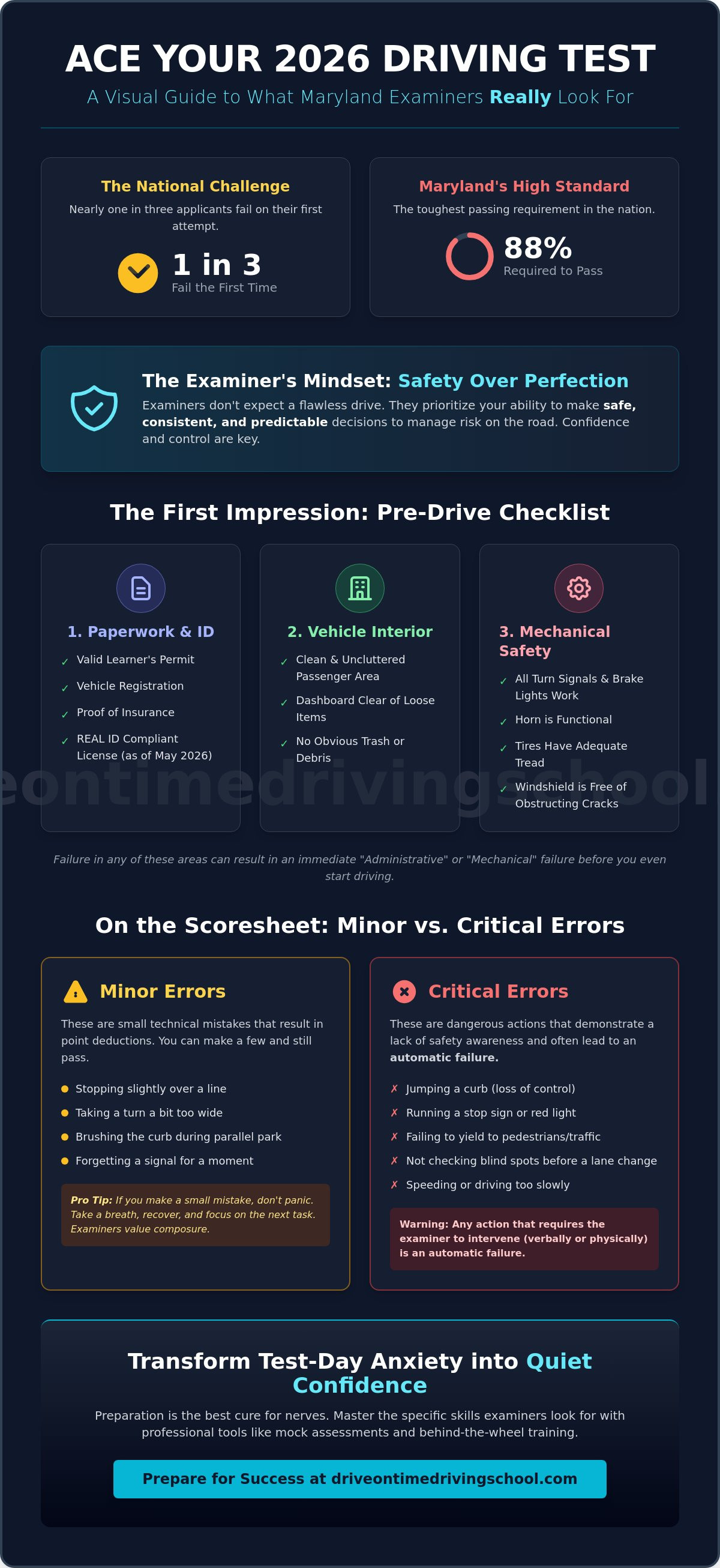
First, it's crucial to understand the examiner's role. They are not instructors or coaches; they are objective MVA-certified evaluators. Their job is to administer a standardized test and observe your ability to safely operate a vehicle according to Maryland law. They follow a strict scoresheet and are looking for consistent evidence of safe driving habits.
- The Primary Goal: Every examiner's mission is to determine if you are a "safe" driver who makes sound decisions without guidance.
- Perfection Isn't Required: The test uses a point-based system. Small technical errors, like a slightly wide turn, may result in a minor point deduction, but they won't necessarily cause you to fail.
- Technical Error vs. Safety Hazard: There's a big difference between a minor mistake (e.g., forgetting a turn signal in an empty lot) and a critical safety error (e.g., failing to yield to a pedestrian). The examiner’s focus is on the latter.
- Confidence is Key: Examiners assess your confidence through your smooth, decisive control of the vehicle. Hesitation or jerky movements can signal a lack of preparedness.
The Definition of a "Safe" Driver in 2026
According to the MVA, a safe driver is one who internalizes and consistently demonstrates core safety habits. It’s not about just remembering the rules for the test; it’s about showing that these rules have become second nature. Examiners look for two main qualities:
- Consistency: You follow traffic laws, check your mirrors, and scan for hazards without needing to be prompted.
- Predictability: Your actions, such as using turn signals well in advance, clearly communicate your intentions to other drivers, cyclists, and pedestrians.
Safety habits are the foundation of the entire driving exam, proving you can manage risk independently.
Minor vs. Major Errors: What Really Counts
The MVA scoresheet has a threshold for point deductions. While a single minor error won't disqualify you, a pattern of them suggests you haven't developed the necessary skills. For example, lightly touching a curb during a maneuver might be a small deduction, but hitting it with force could be considered a loss of control.
- Accumulated Points: Multiple minor errors, like repeated wide turns or inconsistent speed, can add up and lead to an unsatisfactory result.
- Mental Recovery: If you make a small mistake, take a deep breath and refocus. Examiners want to see that you can recover your composure and continue driving safely. Letting one error rattle you can lead to more significant ones.
The Pre-Drive Inspection: Passing the "First Impression" Test
Your test begins before you even start the engine. The MVA examiner will conduct a vehicle safety inspection to ensure your car is roadworthy. Arriving in a vehicle that fails this inspection results in an automatic reschedule, so it's critical to prepare your car ahead of time.
- Vehicle Safety Standards: Your car must meet all Maryland MVA safety requirements.
- The "Administrative Pass": Have your learner’s permit, the car’s registration, and proof of insurance organized and ready to hand to the examiner
- Knowledge of Controls: You'll be asked to demonstrate knowledge of your vehicle’s secondary controls, like the wipers, defroster, and lights.
- A Professional Tone: A clean, clutter-free car shows the examiner that you take driving and safety seriously.
Mechanical Must-Haves for Your Vehicle
Before leaving for the MVA, do a quick check of these essential components to avoid being turned away:
- Lights and Signals: Ensure your brake lights (all three), turn signals (front and back), and headlights are all working. Have someone stand outside the car to verify.
- Horn: Give the horn a quick tap to make sure it functions correctly.
- Tires and Windshield: Your tires must have adequate tread, and the windshield cannot have cracks that obstruct your view.
- Mirror Positioning: Adjust your rearview and side mirrors for maximum visibility before the examiner even gets in the car.
Knowing Your Dashboard and Controls
Fumbling to find the hazard lights or defroster shows a lack of familiarity with your equipment. Be prepared to instantly locate and operate the following:
- Hazard lights (four-way flashers)
- Emergency/parking brake
- Windshield wipers and defroster settings
- Headlights (low and high beams)
Core Driving Competencies: What Is on the MVA Scoresheet?
During the on-road portion of the test, the examiner will grade you on four primary areas of competence. These are the fundamental skills that demonstrate your ability to navigate real-world traffic safely.
- Observation Habits: Are you actively scanning your environment? This is arguably the most important skill examiners look for.
- Speed Management: Driving too slowly can be just as dangerous as speeding. You must adapt your speed appropriately to the posted limit and current road conditions.
- Lane Positioning: Consistently maintaining a safe position in the center of your lane demonstrates good vehicle control.
- Right-of-Way: You must show that you understand and correctly apply right-of-way rules at intersections, crosswalks, and when changing lanes.
The Art of Observation and Scanning
The examiner needs to see physical proof that you are aware of your surroundings. This is where the "exaggerated head turn" becomes your best friend.
- Mirror Checks: Make a habit of checking your rearview and side mirrors every 5-8 seconds.
- The Blind Spot Check: A quick, decisive glance over your shoulder before every lane change or merge is mandatory. Turning only your head, not your whole body, is key
- Scanning Intersections: Look left, right, and then left again before proceeding through any intersection, even when you have a green light or the right-of-way.
Control and Maneuvering Skills
How you handle the vehicle speaks volumes about your confidence and training. The examiner is looking for a smooth, controlled ride.
- Smoothness: Avoid jerky acceleration and abrupt braking. Apply gentle, steady pressure to both pedals.
- Steering Technique: In Maryland, the MVA recommends the "push-pull" steering method for its stability and control.
- Executing Turns Signal at least 100 feet before your turn, slow down before entering the turn (not during it), and finish in the correct lane.
Critical Driving Errors: Avoiding the Automatic Failure
While minor point deductions are survivable, a Critical Driving Error will end your test immediately. These are actions that create an immediate safety hazard for you, the examiner, or the public.
- Defining the "Automatic Fail": Any action that compromises immediate safety or violates Maryland traffic law.
- Traffic Violations: Running a red light or rolling through a stop sign are classic examples of immediate disqualification.
- Examiner Intervention: The test will end if the examiner has to take physical control of the steering wheel or give a sharp verbal command (like "STOP!") to prevent a collision.
- Dangerous Maneuvers: This includes actions like pulling out in front of oncoming traffic, forcing another driver to take evasive action, or driving onto a curb or sidewalk.
Common Mistakes That Lead to Immediate Disqualification
Be especially mindful of these common critical errors during your test:
- Failure to yield to pedestrians in a crosswalk or to an emergency vehicle with its lights and siren active.
- Exceeding the speed limit, especially in a marked school zone or construction zone.
- Incomplete stops. You must come to a full and complete stop behind the white line before proceeding.
How to Handle Unexpected Road Situations
Your ability to stay calm under pressure is a critical skill. If an unexpected situation arises, how you react is part of the test.
- Emergency Vehicles or Aggressive Drivers: If you hear a siren, safely pull over to the right and stop. If another driver is acting aggressively, create distance and focus on your own safe driving.
- Taking a Wrong Turn: If the examiner tells you to turn right and you miss it, do not panic or make an unsafe correction. Continue driving safely and say, "I missed that turn, I will take the next safe right." This is not a failure; it shows good judgment
Remaining calm is the best way to prevent a small, unexpected event from turning into a critical error.
Mastering the Test with Professional Confidence
The single best way to reduce test-day anxiety is through thorough preparation. Professional instruction helps transform Maryland MVA requirements from a list of rules to remember into deeply ingrained safety habits.
- Reduce Anxiety: Professional instruction provides the structure and repetition needed to build true confidence behind the wheel.
- Practice with Mock Tests: Simulating the MVA skills test with a certified instructor is the most effective way to prepare for the pressure of the real thing.
- Build Long-Term Habits: The goal isn't just to pass a test, but to become a safe driver for life. If you've developed bad habits, a professional can help you correct them before they cost you points. For drivers who need to fix recurring issues, programs like the Maryland Driver Improvement Program are designed to reinforce these core safety principles.
The Value of Behind-the-Wheel Practice
There is no substitute for supervised, real-world driving experience. Targeted practice with a professional mentor helps you:
- Break bad habits like "rolling stops" or forgetting blind-spot checks before they become automatic.
- Get comfortable with having an observer in the passenger seat evaluating your every move.
- Receive specific, actionable feedback on your scanning and observation techniques to ensure the examiner sees you doing them correctly.
Final Tips for Test Day Success
On the day of your test, set yourself up for success with these final preparations:
- Rest and Nutrition: Get a good night's sleep and eat a balanced meal before your test. A calm body supports a calm mind.
- Arrive Early: Get to the MVA facility at least 15-20 minutes early to check in without rushing and get familiar with the environment.
- The Success Mindset: Treat the examiner as a passenger you are responsible for keeping safe, not as a judge. Focus on demonstrating your competence and safety awareness.
Ready to polish your skills and pass with confidence? Book a supplemental behind-the-wheel session with one of our certified instructors today.